
Confusing the distinct concepts of private key vs. seed phrase, or simply mismanaging them, can be the cause of permanent fund loss or theft. Unlike traditional banking, Bitcoin operates on a model of self-sovereignty.
There is no customer service line to call to reverse transactions or reset login credentials. In this decentralized environment, you are the sole guardian of your wealth, bearing total responsibility for its security.
This article aims to clarify the specific roles, differences, and security needs of each component to ensure robust protection of your coins.
What Is a Private Key?
A private key is a sophisticated alphanumeric code that proves ownership of Bitcoin. It acts like a digital signature for a specific address and is mathematically linked to a public key, which is shared to receive funds. Your wallet contains many of these keys, and each one corresponds to a different address. Its primary role is to facilitate the movement of coins.
Example:
L55Ez7heSEmtjkgPveagRym8GaLuKV5NvAWRDmUc5JcZWM7aaWN4When you initiate a transaction, the wallet uses your private key to create a digital signature. The network nodes then verify this signature to confirm the transfer is legitimate. Without this unique cryptographic proof, the blockchain will not accept your transaction.
Because it controls your funds, the private key must remain completely secret. If anyone else sees it, they can steal your Bitcoin. If you lose it, access to those funds is lost forever.
What is a Seed Phrase?
A seed phrase, also commonly known as a mnemonic or recovery phrase, is a list of words that acts as a master backup for your wallet. It is typically 12 to 24 words long, taken from a standardized list, like BIP39. Its primary role is disaster recovery.
Example:
float post gym list bullet garlic muscle wisdom reunion road rude driveIf you lose your hardware wallet or switch devices, you can input these words to restore your wallet. The software uses them to regenerate your private keys and retrieve your Bitcoin.
Because it acts as the master key, it must be kept secure. Anyone with access to these words can control your entire wallet.
Differences Between Seed Phrase and Private Key
Scope and Function
The scope of these two components differs significantly.
A private key controls a single public address. It authorizes the spending of funds from that specific location only. Losing one private key means losing access to the funds at that one address.
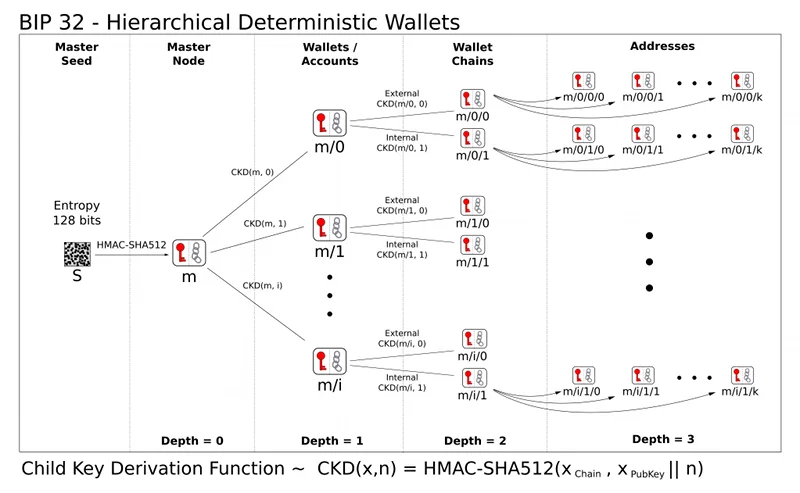
In contrast, a seed phrase acts as a master password for the entire wallet. It generates and recovers all private keys within that wallet structure. It provides access to every current and future address in your account.
The frequency of use also distinguishes them. Private keys are utilized for every transaction. They are used constantly to sign and authorize payments, though the wallet software usually handles this automatically. You rarely interact with the raw private key itself.
The seed phrase, however, is used only for setup and recovery. You input it once during initialization and only need it again if your device is lost or fails. It is not required for daily spending, but it must be stored securely for backup purposes.
Generation and Structure
Both components also differ in their composition.
Private keys are long, alphanumeric characters derived from cryptographic math. They are difficult for humans to read or memorize accurately. Seed phrases consist of 12 to 24 words from a standardized list. This format allows for easier transcription and recall by users.
Security Priority
Both credentials are similar, as they demand the highest level of protection. However, the seed phrase represents the single point of failure for the entire wallet. Its loss results in the permanent loss of all associated funds.
Secure storage is therefore critical for long-term fund safety.
FAQ
Is a seed phrase the same as a private key?
No. It acts as a master backup for your entire wallet, while a private key controls a specific address. The seed phrase generates the private keys. You use it for recovery and the private key for spending.
How does a seed phrase generate private keys?
The wallet software uses a mathematical formula to convert the seed phrase into a unique number. This number acts as a master root. The wallet then uses this root to calculate every individual private key for your addresses.
Read more: BIP32: Deriving a Tree of Keypairs From a Seed.
Can I derive my seed phrase from a private key?
No. The process works in one direction only. You cannot reverse the math to extract the seed phrase from a private key. This is a security feature, not a flaw. It prevents someone who compromises a single private key from obtaining the master backup for your entire wallet.
How many private keys can one seed phrase create?
A single seed phrase can generate an almost infinite number of private keys. It’s the single source of truth for all of them. The hierarchical structure allows the wallet to create a new key for every transaction you make.
Do I need a seed phrase if I have the private key?
Yes. A private key only controls a single address. Managing every key individually is impractical and insecure. The seed phrase acts as a master backup that generates and recovers all your keys. It ensures you can access your entire wallet, not just one part of it.
Conclusion
Private key vs. seed phrase: Both components play distinct but interconnected roles in Bitcoin security. Private keys facilitate the daily spending of funds, while seed phrases serve as the master backup for recovery.
Confusing these two or mishandling them creates significant risks. Because the seed phrase provides access to your entire wallet, it represents the single point of failure. Protecting this master backup is therefore the most critical step in securing your coins.
Using durable, tamper-evident storage ensures that your funds remain safe, accessible, and under your exclusive control.