
Multisig changes the shape of your backup. Seed phrases are only half of it. The other half is the descriptor: a short file that defines your wallet and its spending rules.
Restore your seeds without the descriptor, and you still have no wallet. Without it, every seed must survive. A key you no longer hold cannot be guessed.
You protect more parts, but the arithmetic is on your side. Your threshold sets how many keys you can lose: a 3-of-5 absorbs two, a 2-of-3 absorbs one, a 2-of-2 absorbs none. The descriptor has no such slack. Lose your last copy, and the seeds stop being enough.
This guide covers what to back up, how many backups you need, and where each one lives. It also shows how to test recovery before you trust any of them.
What You Need First
You need three things in place before backing up your multi-sig wallet:
- The wallet exists, and it has already received and spent bitcoin.
- Every seed phrase is written down, legible, and already checked against its device.
- The descriptor is recorded in full.
With these in place, you never waste backups on a wallet that cannot spend. A failed test costs time, not the wallet.
The Two Things That Must Survive
They fail differently. Both must survive, and only one must stay secret.
The Seed Phrases
Each seed phrase regenerates one signing key: a single cosigner’s slot in the wallet. That key holds one share of the spending authority. It has to stay secret, and it has to last.
In multisig, the threshold, sometimes called the quorum, sets how many keys you can lose and how many it takes to steal. A 2-of-3 wallet sets it at two.
A seed phrase is only safe while it stays secret. Once it leaks, it does not empty the wallet, but it spends the tolerance you had for losing that key. It counts as lost until you rotate it out, which means a new wallet and a move of funds.
If any cosigner uses a BIP39 passphrase, that passphrase is a second secret, backed up separately from the seed. Without it, the seed restores a different signing key. See the FAQ.
The Descriptor
The descriptor carries no spending authority but records your wallet’s structure. That structure covers:
- Threshold and key count: 2 of 3 means two signatures from three keys.
- Script type: P2SH (legacy), P2WSH (native SegWit), nested P2SH-P2WSH, or P2TR (taproot).
- Address rule: multi or sortedmulti.
- One extended public key (xpub) per cosigner, with its origin: the fingerprint and derivation path, such as
[A1B2C3D4/48'/0'/0'/2'].
A descriptor ends in a checksum, such as #abcd1234. Any edit or typo makes the import fail, so copy it and never retype it.
Its name varies. Bitcoin Core specifies output script descriptors; wallet software shortens it to descriptor, or calls it a wallet policy or configuration. They all mean the same record.
The descriptor lives in your wallet software, which is the part people forget to back up. A signing device may register it to display and verify addresses, but that registration is not a backup.
Duplicating it costs nothing in spending security. Anyone who reads it learns how your wallet is built, not how to spend from it.
Privacy is the real cost. The descriptor exposes every address, the current balance, the full history, and all future addresses. The limit on duplication is who you trust with that view.
With every seed in hand, a determined person can sometimes reconstruct a descriptor by trying script types, paths, and key orders. That is a recovery project, not a plan, and it ends the moment one key is missing.
How Many Backups You Actually Need
You need one backup per key. A 2-of-3 wallet needs three, and a 3-of-5 wallet needs five.
Your tolerance is the key count minus the threshold. A 2-of-3 tolerates the loss of one key, and a 3-of-5 tolerates two. A 2-of-2 tolerates no loss at all.
Fewer backups than keys leave at least one key without a durable copy. That key then depends on a working device. If the device dies, the key goes with it.
That count is a floor, not a ceiling. A duplicate protects that key against one copy being destroyed, not against the key leaking; a leaked seed is a lost key, however many copies exist. Each copy still adds a holder to trust and another place the key can be found.
The arithmetic only holds if the copies stay apart. Two keys backed up in one house make a 2-of-3 behave like a 2-of-2. Separation has its own rules later in this guide.
The descriptor does not follow this arithmetic. It tolerates no loss at all, so it is not counted, only copied.
What Goes with Each Backup
Each backup carries the two things that must survive:
- One seed phrase only, because more would recreate the single point of failure you are trying to avoid.
- One descriptor copy, so the structure survives wherever a seed does.
One key and one descriptor still cannot spend, so keeping them together adds no spending risk. The cost is privacy, not spending.
A passphrase never goes on the backup. Where it does go is covered in the FAQ.
Metal is the right material for the seed backup because it should outlast you. For the full comparison, see the best way to store a seed phrase; DIY seed phrase storage covers making your own from raw materials. If you would rather buy a purpose-built backup and mark it yourself, see metal seed phrase backups.
Take the export when your wallet offers one. A standard descriptor imports into any descriptor-aware coordinator, and it prints as a QR code, so nobody has to type it back in during a recovery. Where there is no export, copy and paste the fields yourself rather than retype: one wrong character leaves a descriptor that will not import.
Print one copy for each backup: text and QR together. Keep a second in your password manager, and a USB stick if you want one. The printed copy is the one that still works when the computer, the account, and the app are all gone. The others are conveniences. This applies to the descriptor only. A seed phrase never goes digital.
Where Each Backup Lives
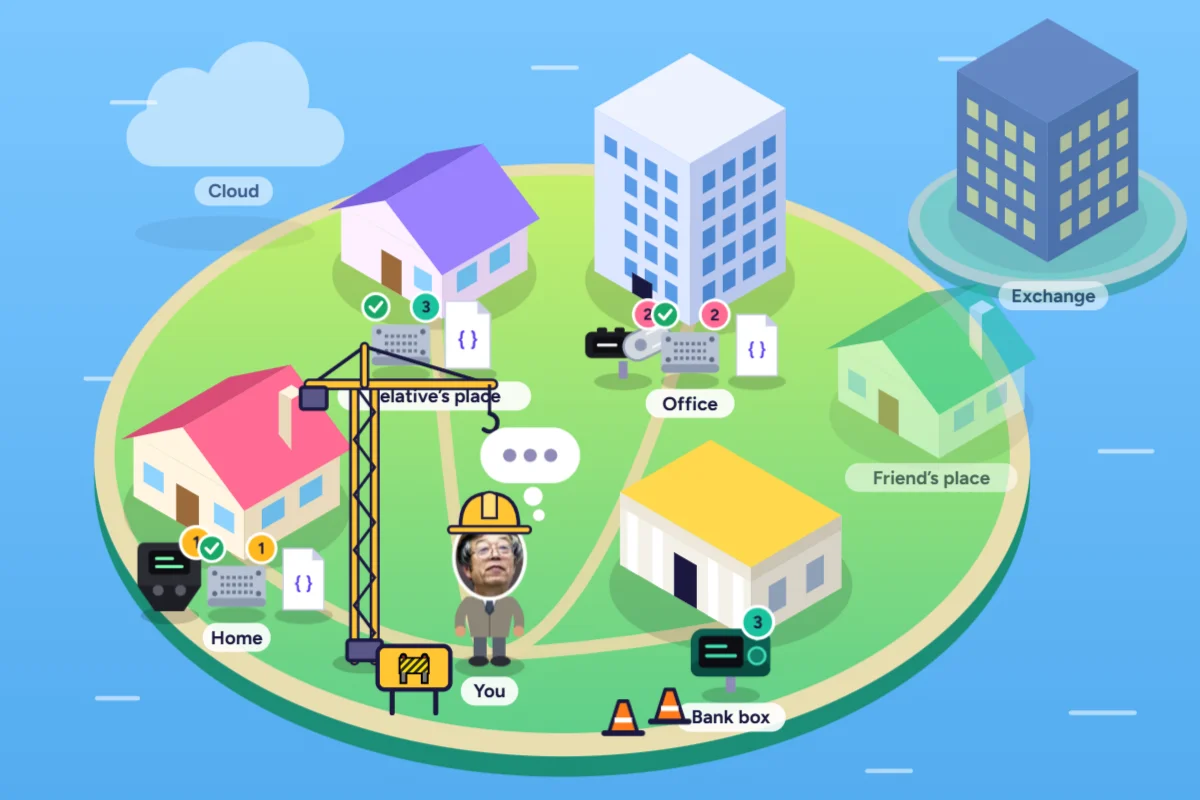
One key per location is the target.
A single location should never hold enough distinct keys to spend. Nor should it hold more keys than you can survive losing. Those rules set the ceiling, not the target.
A duplicated key may sit in two places. Two different keys should never share one.
Two locations share a failure when one fire, one flood, one burglary, or one seizure reaches both. Distance is a proxy for separation, not proof of it. Two friends who speak every week are one location, however far apart they live.
Home is the most convenient choice but the most exposed. A safe deposit box resists fire and theft. But its access depends on bank hours and laws that can seal it when your heirs need it.
A trusted relative’s place costs nothing and involves no institution. The real risks are human. They can forget it, show it, die without telling anyone, or be forced to give it up.
Choose locations that fail differently, because that is what separation buys.
The same rule applies to people: one key per holder, and never enough to spend.
A holder needs to know when to hand the backup over (on your death or incapacity) and who to give it to. They do not need to know what it protects or what it is worth.
Verify Your Backup by Restoring It
Your backups are a claim until you rebuild the wallet from them. The first stage proves each key. The second proves the backup.
If your descriptor copy has not yet been imported cleanly, do that before wiping anything. The file in your coordinator is the only known-good copy, and this is the last moment it can be checked.
Then record the wallet’s first receiving address while the coordinator is still there. It is how you will know the rebuild produced the right wallet.
Work from the least destructive test to the most, so a failure costs time rather than a key. Keep the working copy of each seed until its backup passes, and test one device at a time.
Restore Your Keys
A backup you cannot read has failed, and checking it against the screen will not tell you. You know what the words should be, so your eye reads them that way. Whoever needs this backup next will not have that advantage.
That is what restoring tests. So wipe one device and restore its seed from the backup. Type the words, or their first four letters, into the signing device, never into the coordinator or a computer. Misread one, and the checksum fails, or the fingerprint comes out different.
An empty single-sig wallet is the expected result. That is the key’s own wallet, not your multisig.
What must match is the cosigner. Compare the device’s fingerprint and its extended public key at the recorded path against that key’s origin in the descriptor.
If the cosigner uses a passphrase, apply it first: without it, the device reports a different fingerprint, and a good backup looks like a bad one.
One restored seed proves one part. Do not wipe the next device until this one matches. If it does not, stop: the backup is the suspect, and the working copy is still there to make another.
Restore Your Wallet
Start by deleting the wallet from your coordinator or opening a fresh profile. If you reopen the existing wallet, you have tested nothing: the original was never gone.
Rebuild from your descriptor backup and add the keys you have restored. Where a device had registered the wallet, register it again from the same copy. If your wallet cannot import a descriptor, rebuild from the file or the xpubs you recorded.
The wallet must reappear with the same addresses and the same history. If you labelled addresses or transactions, those labels are gone. They are cosmetic; the funds and history are unaffected.
Confirm the first receiving address matches the one you recorded. If it does not, stop. The descriptor copy is the suspect, not the keys you just proved.
A matching address proves you have the right wallet. It does not prove you can spend from it. Receive a small amount and confirm it lands in the wallet; then spend it and confirm the change returns to the same wallet.
Record what worked: software version, firmware, script type, and derivation path. That note turns a future recovery from an investigation into a procedure.
Once every backup has passed, destroy the working copies. They were never the backup, only the reference you typed from. A copy you no longer need is one more thing to lose, and one more to be found.
How the Person Who Inherits Uses Your Backup
Your backups work when the person who inherits can use the wallet, without having ever seen it. Until then, it is an arrangement between you and your memory.
Prepare one document with two parts.
The first is an inventory that records:
- The threshold and the key count.
- Whether a passphrase exists and who holds it.
- How many backups exist and which slot each covers.
- Where each backup is kept and who can reach it.
No seed phrases, no prefixes, no passphrases. A document carrying a secret becomes the single point of failure the rest of this guide worked to remove.
The second is the sequence:
- Gather enough backups to reach the threshold, plus the descriptor.
- Recover the wallet, following detailed steps.
- Move the funds into a wallet they control.
Store a copy, and give one to the person who will act. Keep them apart, and apart from the backups this document names.
The document is not a backup, so losing it costs no bitcoin. It can still cost all of it. A backup nobody can identify is a backup nobody uses. It is thrown out with everything else, and the funds stay where they are.
One warning. Do not file it with your will. Wills become public in probate in many jurisdictions, and this document is a description of where your bitcoin lives.
There is a simple test. Hand the document to the person named on it and ask what they would do first. If they have to guess, it is not finished.
This is the minimum for the backups to be found and used. Executors, legal structures, and dead-man switches are a separate job.
FAQ
What if a cosigner uses a BIP39 passphrase?
The other cosigners are unaffected. This key alone becomes two secrets: the seed phrase, and the passphrase. Lose the passphrase, and the seed phrase restores a different key. Its fingerprint no longer matches the descriptor, so the device cannot fill that cosigner slot. That spends tolerance rather than funds, unless it drops you below the threshold. Test the two together before you rely on them.
Where does the passphrase go?
Never with the seed, but treat it like one: it has to stay secret, and it has to last. Put it on a separate object, in a separate place, on a separate failure path. A sealed envelope, a box that holds no backup, a short passphrase stamped on its own plate. Never the same envelope. Never a password manager. The pair makes a single signing key. In the wrong hands, that spends tolerance, not funds. Give it to a holder who does not hold that key’s backup. Record that much in the inventory, and keep the passphrase itself out of the document.
Can I rebuild a descriptor if every copy is lost?
Sometimes, and only with every seed in hand. Derive each xpub from its seed, then try script types, paths, and key orders until an address matches one you know. Two things make the rebuild impossible: a missing seed, and a lost passphrase. Either removes an xpub you cannot guess. A wrong descriptor still imports cleanly, so only a matching address proves the result. If none survives, the rebuild stays a guess.
What if the person who inherits can’t reach the threshold?
Once the keys are gone, nothing can be done, which is why the fix belongs in your instructions. Below the threshold, the funds cannot move: no reset, no support line, no recovery service. So write the instructions while you can still change the outcome. Warn them that anyone offering to recover the funds is a thief. List every place a key might still be, so nothing is ruled out before the search. Name a second contact for every backup, so an unreachable holder costs days rather than the wallet.
I run more than one multisig wallet. What changes?
Everything multiplies except the tolerance. Two wallets mean two descriptors, two sets of keys, and a separate count of backups for each. What does not carry over is a seed: never use one key in two wallets. A single key in two descriptors ties their failures together. One leak then spends a slot in each, and the wallets stop being independent. Give each wallet its own document, and name the wallet on every backup. Two backups from two wallets look identical in a drawer. The night you need them is not the night to guess.
Is a coordinator the same thing as a wallet?
Yes. It is the same software, with a different job. A program becomes a coordinator when it holds a multisig descriptor and asks several devices for signatures. Otherwise it is a wallet, and most people say so. Sparrow, Specter Desktop, and Nunchuk are the three usually meant. They are interchangeable, as long as the descriptor is a standard one. Install a different coordinator, import the descriptor, and your wallet is back.
Conclusion
A multisig backup has two halves and one arithmetic.
Each seed restores one signing key, and no key spends alone: each needs a backup of its own, on a separate failure path.
The descriptor is the half that gets forgotten. It restores the wallet, and it has no tolerance at all, so it gets copied wherever you trust the privacy.
What separates a backup from a belief is the restore. Test each key, rebuild the wallet, confirm the address, then write down what worked and who holds what. Do that once, and your heirs inherit a procedure instead of a puzzle.
The Multi-Sig Backup Key Set covers a 2-of-3: one lost key is survivable, and no single key can spend. It includes the punches to mark them.